
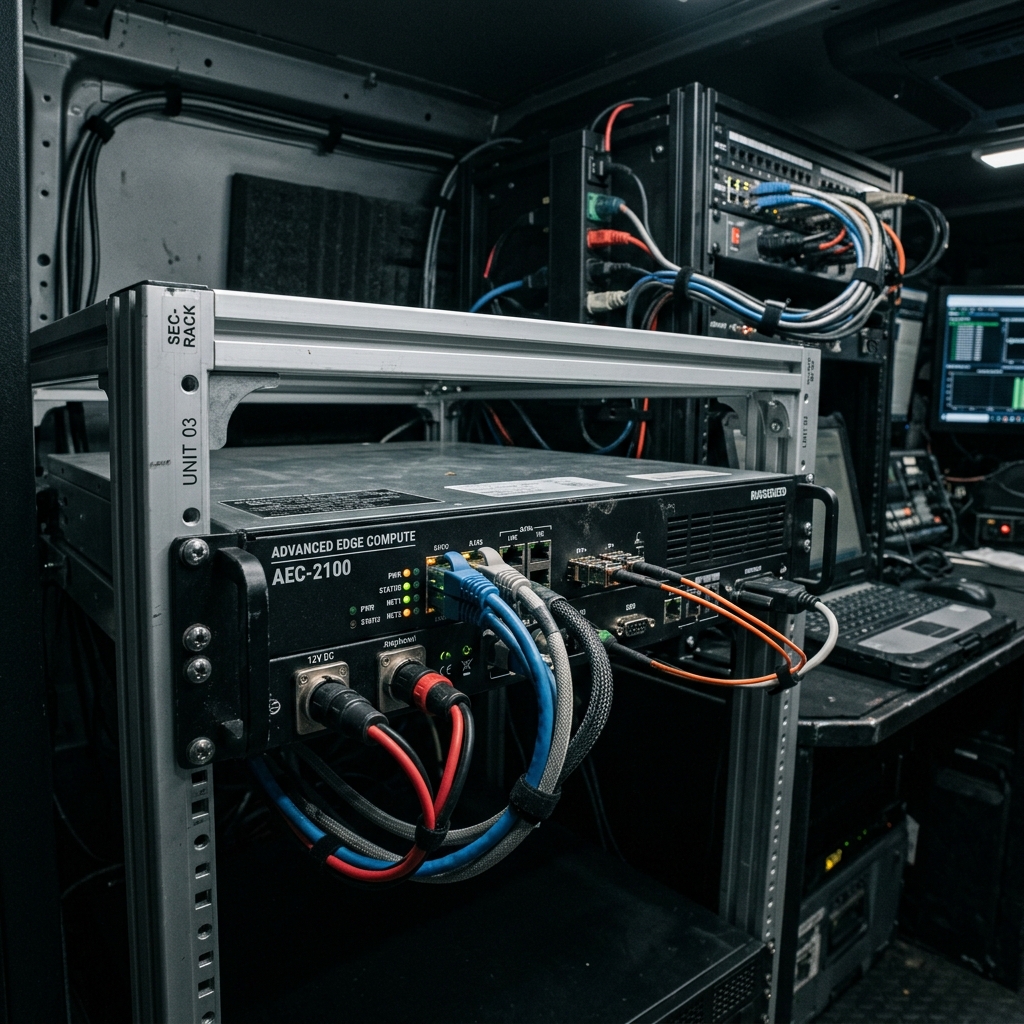
The legacy model of "Sensor to Cloud" is hitting physical limits. Bandwidth saturation, latency at the millisecond scale, and data sovereignty laws are forcing a return to decentralized compute. This is the domain of the Edge Server.
Unlike a standard industrial PC, which is typically a single-purpose "thin client" or machine controller, an edge server is a multi-workload platform designed to manage the data flow of an entire facility.
Edge vs. Cloud vs. IPC: The Compute Spectrum
An engineer must decide where the "Intelligence" lives. This matrix defines the boundaries.
| Metric | Industrial PC (Gateway) | Edge Server (Node) | Cloud Computing (Centralized) |
|---|---|---|---|
| Logic focus | Single machine control | Site-wide aggregation | Global analytics / Modeling |
| User access | Human Machine Interface (HMI) | Management Console | Web API / Dashboard |
| Storage | Local cache (<1TB) | High-capacity (10TB - 100TB) | Infinite (Elastic) |
| Connectivity | Serial / 1GbE | 10GbE / 25GbE / SFP+ | Public Internet / VPN |
| Reliability | Wide-Temp, Fanless | Ruggedized Server-Grade | Redundant Data Center |
The Architecture of the Edge
To design an effective edge server deployment, engineers must navigate three technical layers:
1. The Virtualization Layer (Hypervisors)
Edge servers rarely run a single OS. They utilize Hypervisors to run multiple virtual workloads on one physical machine.
- Type-1 Hypervisors (ESXi, Proxmox, KVM): Run directly on the hardware. For edge deployments, KVM is often preferred for its lower overhead and native integration with industrial Linux distributions.
- Containerization (Docker/K8s): For microservices like MQTT brokers or AI inference nodes, containers offer much faster startup and lower memory footprints than full VMs.
2. The Fog Computing Hierarchy
The "Edge" is not a single point; it is a hierarchy:
- Level 1 (Sensor Nodes): Basic data collection.
- Level 2 (Edge Servers): Local analysis, filtering, and real-time control.
- Level 3 (Regional Fog Nodes): Aggregating data from multiple Edge Servers before sending "clean" data to the cloud.
3. Networking Throughput & SFP+
Standard 1GbE connections are often insufficient for edge servers aggregating 20+ high-resolution camera streams.
- The Rugged Implementation: Industrial edge servers often feature SFP+ ports for fiber-optic connectivity, providing 10GbE or 25GbE throughput with immunity to the EMI (Electromagnetic Interference) found on factory floors.
Security: The Hardware Root of Trust
Because edge servers are physically "out in the field," they are vulnerable to physical tampering.
- TPM 2.0 (Trusted Platform Module): Essential for storing cryptographic keys and ensuring that the system only boots from trusted software.
- Secure Boot & Drive Encryption: In the event a server is physically stolen from a remote station, these measures prevent data from being extracted.
- Intrusion Detection: Many industrial server chassis include switches to alert the network if the server panel is opened.
Infrastructure Readiness Checklist
Use this 5-point checklist before deploying a server node to the edge:
- Virtualization Overhead: Have you accounted for the ~5-10% CPU/RAM overhead required by the hypervisor?
- Storage Endurance: Are you using Enterprise-Grade NVMe (U.2/M.2) with high TBW (Terabytes Written) ratings for constant data logging?
- Out-of-Band Management (IPMI/BMC): Can you remotely reboot, re-install the OS, or check temperatures if the main OS crashes?
- Network Redundancy: Does the server have dual-power and dual-networking (Teaming/Link Aggregation) to survive a single cable failure?
- Thermal Margin: Servers generate intense heat. Is the mounting location capable of dissipating a constant 100W - 200W thermal load?