With DDR5 reaching maturity and Intel's 14th Gen processors cementing the transition, industrial system integrators are facing a critical lifecycle decision: stick with the proven reliability of DDR4 or adopt the new DDR5 architecture.
In consumer hardware, the debate often focuses purely on gaming framerates. But in industrial computing—where dust, vibration, extreme temperatures, and 24/7 autonomous operation define the environment—the leap from DDR4 to DDR5 is less about raw speed and more about a fundamental shift in system architecture.
Why it matters
Choosing between DDR4 and DDR5 dictates the entire foundation of your deployment platform. Memory type determines the CPU generation, the motherboard chipset, and the thermal constraints of your fanless enclosure.
In industrial edge deployments, migrating to DDR5 isn't just a simple RAM swap. The decision impacts:
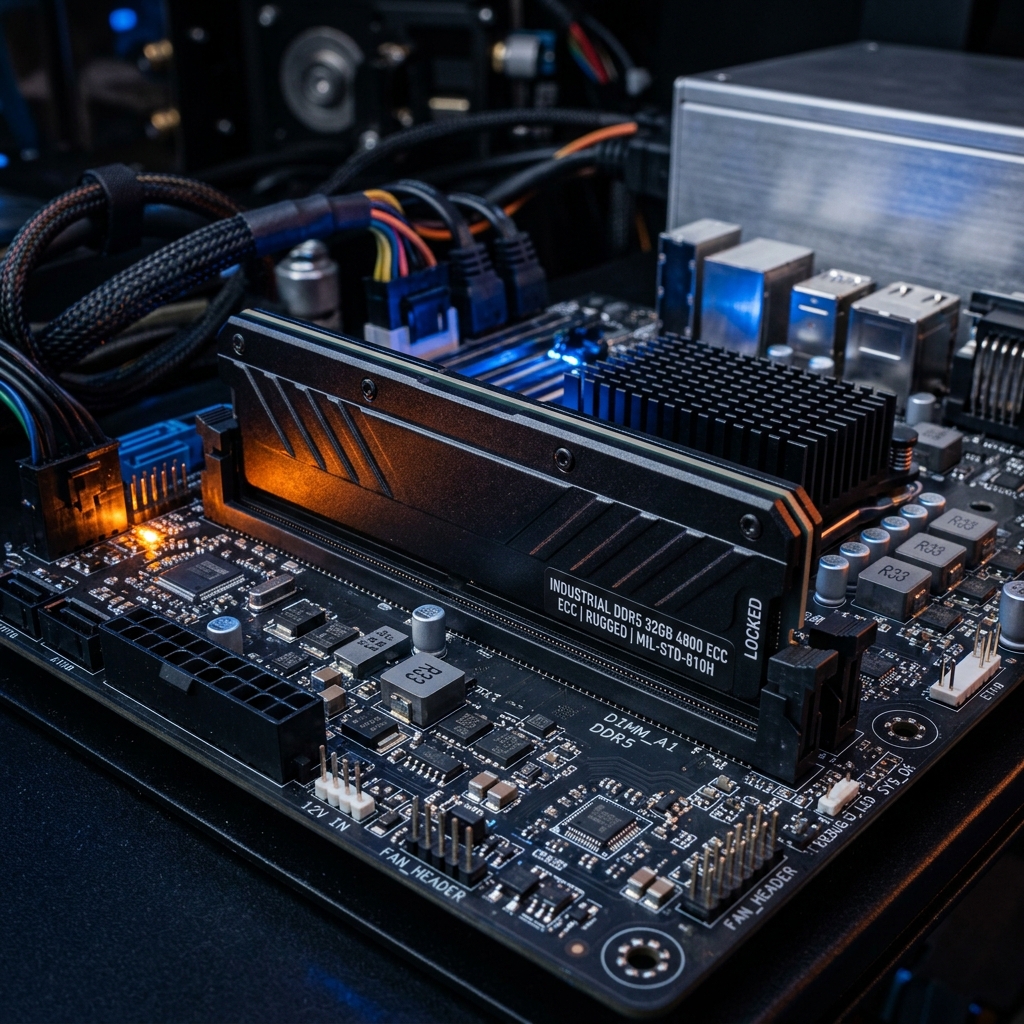
- Thermal Budgets: DDR5 modules generate localized heat differently because power regulation moved from the motherboard directly onto the memory stick.
- Data Integrity: Mission-critical robotics and medical devices must understand the nuances of DDR5's new error correction mechanisms.
- Edge AI Throughput: High-megapixel Automated Optical Inspection (AOI) systems are frequently memory-bandwidth bottlenecked, a constraint DDR5 specifically alleviates.
Comparison table
Here is the engineering decision matrix for industrial hardware selection:
| Specification | DDR4 | DDR5 | Industrial Impact |
|---|---|---|---|
| Max Standard Speed | 3200 MT/s | 6400+ MT/s | DDR5 is vastly superior for multi-stream AI camera feeds. |
| Channel Architecture | Single 64-bit | Dual 32-bit (per DIMM) | DDR5 improves CPU multi-core efficiency, preventing data starvation. |
| Operating Voltage | 1.2V | 1.1V | Lower voltage in DDR5, but the PMIC generates localized heat. |
| Power Management | Motherboard VRMs | On-Module (PMIC) | DDR4 is easier to cool passively in sealed fanless PCs. |
| Error Correction (ECC) | Checksum on CPU | On-Die ECC standard | DDR5 masks internal chip errors, but Side-Band ECC is still required for transmission errors. |
Real-world use cases
Understanding workload characteristics is critical when selecting memory architecture.
🏭 Factory Automation (SCADA / PLC)
Typical SCADA systems and PLC controllers have predictable workloads with low memory bandwidth requirements. DDR4 remains the preferred option due to its stability, mature ecosystem, and lower thermal footprint.
👁 Machine Vision (AOI Systems)
High-resolution AOI systems processing multiple camera streams benefit significantly from DDR5. The increased bandwidth reduces frame buffering delays and improves inspection throughput.
🤖 Edge AI Inference
Running models such as YOLO or TensorRT pipelines at the edge is heavily memory-bandwidth dependent. DDR5 eliminates bottlenecks in multi-threaded inference workloads, making it the default choice for modern AI deployments.
🚄 Transportation & Rolling Stock
In high-vibration environments, traditional DIMM slots can become a reliability concern. While DDR4 is still dominant, emerging form factors like CAMM2 offer better mechanical stability for DDR5-based systems.
Deployment guidance
Moving memory technology into harsh environments requires overcoming several specific engineering hurdles.
1. Thermal Management in Fanless IPCs
In DDR4 systems, voltage regulation was handled by motherboard VRMs, distributing heat across the PCB and chassis.
DDR5 introduces on-module PMICs, concentrating heat on the memory module itself.
In sealed fanless enclosures, this creates thermal hotspots. Industrial deployments must ensure:
- Direct thermal coupling (thermal pads to chassis)
- Wide-temperature certified DDR5 modules
- Conservative frequency tuning under sustained load
2. The "On-Die ECC" Misconception
DDR5 includes On-Die ECC as a baseline feature, primarily to improve manufacturing yield and chip reliability.
Important distinction:
- On-Die ECC = internal chip correction
- Side-Band ECC = system-level data integrity
For robotics, CNC systems, or medical devices, true ECC memory is still mandatory.
3. Edge AI and Memory Bottlenecks
In AI inference pipelines, CPU/GPU idle time is often caused by memory latency and bandwidth limitations.
DDR5's dual-channel per DIMM architecture significantly reduces these stalls, improving overall system utilization.
Recommended configurations
Selecting the right configuration is more important than simply choosing DDR4 or DDR5.
Entry-Level Industrial PC
- DDR4 16GB 3200 MT/s
- Best for HMI, SCADA, and control panels
Mid-Tier Edge AI System
- DDR5 32GB 5600 MT/s
- Balanced performance and thermal output
High-Performance Vision / AI Server
- DDR5 64GB+ 6000 MT/s
- Required for multi-camera AI inference and real-time analytics
Common DDR5 pitfalls in industrial systems
Despite its advantages, DDR5 introduces new risks in industrial environments:
- PMIC Overheating: Localized heat can cause thermal throttling in fanless systems
- Misleading ECC Claims: On-Die ECC is not equivalent to server-grade ECC
- Downclocking Under Load: Sustained workloads may force frequency reduction
- BIOS Compatibility Issues: Early industrial boards may lack stable DDR5 tuning
Understanding these pitfalls is essential before large-scale deployment.
Future Outlook: DDR5, DDR6 and Beyond
As industrial lifecycles span 5 to 7 years, system integrators must plan ahead.
The Rise of CAMM2
CAMM2 replaces traditional DIMM slots with a flat, screw-mounted module design.
Benefits include:
- Improved vibration resistance
- Better signal integrity
- Higher achievable frequencies
This makes CAMM2 highly attractive for rugged industrial deployments.
DDR6 Anticipation
JEDEC is actively developing DDR6, expected around 2027.
- Speeds exceeding 17,600 MT/s
- 4×16-bit subchannels
- Integration with CXL memory expansion
DDR6 will initially target data centers and high-end edge servers before reaching industrial markets.
Checklist
Before standardizing your platform:
- Thermal Rating: Are modules certified for -40°C to 85°C?
- Workload Fit: Does your application actually need DDR5 bandwidth?
- ECC Requirement: Is true Side-Band ECC required?
- Mechanical Stability: Are modules secured for vibration environments?
Recommended hardware platforms
- ITX19D-L26 Mini-ITX Industrial Motherboard: High-performance industrial motherboard supporting multi-channel memory architectures, PCIe expansion, and robust industrial power rails.
- NUC18D Nano-ITX Embedded Motherboard: Compact embedded computing platform featuring high-speed memory slots, M.2 NVMe storage, and 24/7 industrial thermal stability.