
Industrial Robotics
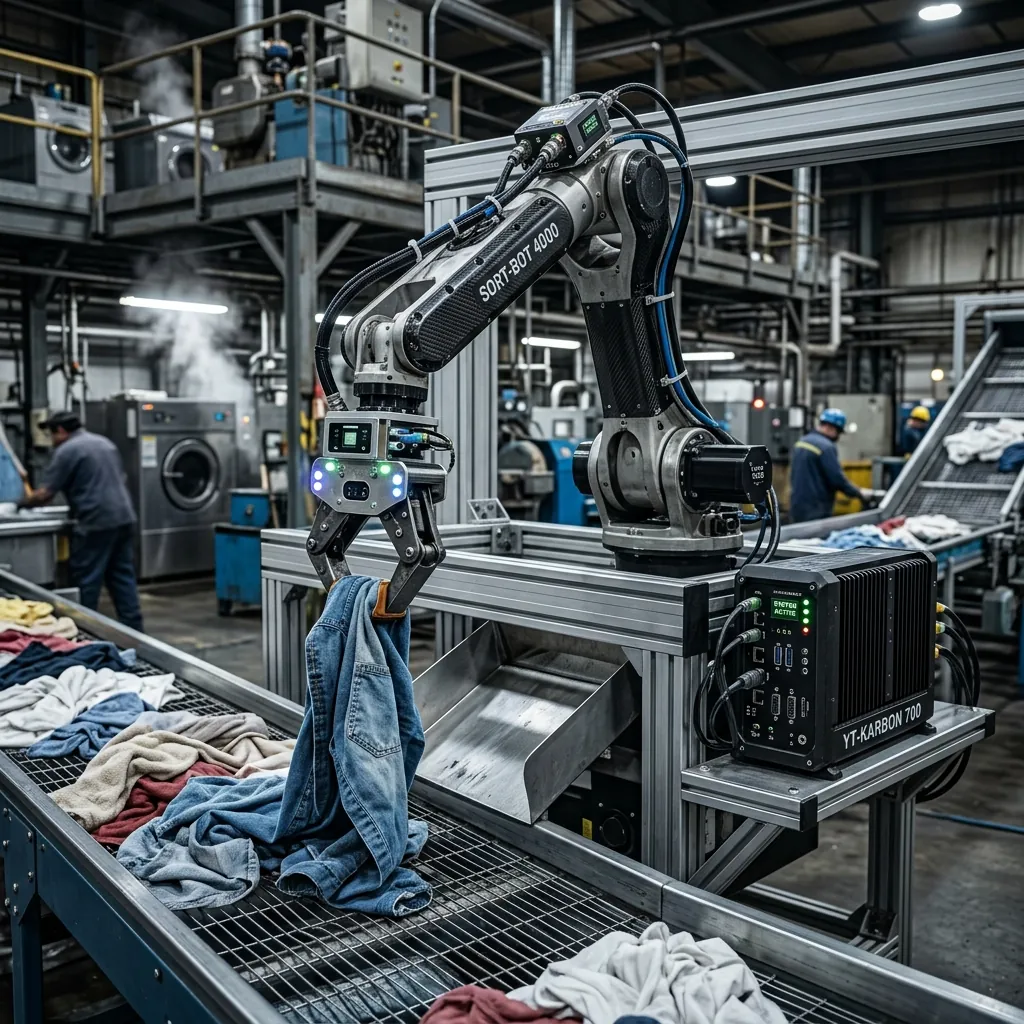
3D Vision & AI Inference for Industrial Textile Sorting
How YX-E 500 GPU-ready edge computing supports 3D vision workloads in automated textile sorting systems.
The Challenge: High-Volume Textile Classification
Industrial laundry and textile handling facilities need to identify garments, foreign objects, and handling risks on fast-moving conveyors. The environment also includes heat, humidity, vibration, and lint that can shorten the life of standard workstations.
The system needed to:
- Process Visual Data Locally: Classify textiles and objects without sending every frame to a remote server.
- Operate in a Harsh Environment: Handle heat, humidity, vibration, and textile fibers.
- Support 3D Data: Feed point-cloud and camera data into a machine vision model with predictable latency.
The Solution: YX-E 500 Vision Node
Yantronic YX-E 500 was selected as the compute platform for the sorting robot.
Engineering Advantages of YX-E 500
- GPU Expansion: The PCIe expansion path supports GPU-accelerated inference for camera and 3D vision workloads.
- Rugged Mechanical Design: Industrial enclosure and mounting options help the system remain stable near moving machinery.
- Thermal Management: Heat-pipe cooling and airflow planning support sustained AI workloads in warm production environments.
Technical Architecture
The system integrates sensing, edge processing, and machine control:
- Sensors: 3D cameras provide spatial data for object and textile classification.
- Edge Processing: The YX-E 500 runs the inference workload close to the conveyor.
- Execution: The control layer sends low-latency signals to sorting actuators and downstream handling equipment.
Impact & Results
The deployment improved the reliability and maintainability of the classification line:
- Throughput Support: Local inference helped keep classification close to conveyor timing.
- Safety Support: Vision-assisted sorting reduced reliance on manual inspection in higher-risk handling areas.
- Maintenance Fit: Industrial thermal and mechanical design reduced the need to adapt consumer workstations for the production floor.